Trilingual highway sign in km in modern Sri Lanka
This is part two of the article "Sri Lanka 50 Years of Metric" giving the story of how Sri Lanka switched to the metric system as this year is the 50th anniversary of Sri Lanka's metric system adoption. Click here to read part one. This part will go over late changes of conversion carried out, the drawbacks that exist today and Sri Lanka's current usage of the metric system. This article will be holding the Sri Lankan government and the National Metric Conversion Authority to account for their performance in converting Sri Lanka to a metric country. The images of the three posters featured in this article were taken at the National Archives of Sri Lanka of the National Metric Conversion Authority Archives Holding #143. The holding details are mentioned in brackets below each poster image.
Late Conversions
Following the National Metric Conversion Authority's disbandment, in the 1980s Sri Lanka was in a
very muddled state of measurement. According to page 326 of "Insight Guides Sri Lanka" Fifth Edition
(1987), during that decade the odometer of some cars were measured in kilometres with other cars in
miles. They also mentioned that most people still thought in imperial units and that the government
was very involved in converting the country to metric. An example of changes that decade was the
new metric construction regulations in 1986 which came as the Planning and Building Regulations.
These regulations were brought under the Urban Development Authority Act via a Government
Gazette.
The Survey Department of Sri Lanka was metricating their maps in the 1980s. These new metric maps had a scale of 1:50,000 and were completed from 1985 to 1996. The way the 1:50,000 scale works is that 1 millimetre on the map is equal to 50,000 millimetres (50 metres) on the ground. Therefore, 1 centimetre is equal to 0.5 kilometre and 2 centimetres is equal to 1 kilometre. If the whole 1:50,000 scale map of Sri Lanka was drawn, it would have the dimensions of 8.64 metres by 4.48 metres which is 38.71 square metres, the size of a small apartment. For practical purposes, the topographic map of Sri Lanka is divided into 92 map sheets with a name and a sheet number.
A New Measurement Act
As a result of Sri Lanka having a new measurement system, an act was needed to legally specify the metric system. A new act was created in 1995 which specified the units to be used in its schedules. This act was known as the Measurement Units, Standards and Services Act, No. 35 of 1995. Mrs. Devalakshmi Balasundaram who was part of the National Metric Conversion Authority, was involved in the drafting of this act. The act established the Measurements Units, Standards and Services Department (MUSSD) in 1997. The MUSSD is responsible for Sri Lanka's use of the International System of Units (SI Units).
Imperial Hangovers
Unfortunately, a noticeable amount of imperial units continue to be used in Sri Lanka. Feet and inches
are still in widespread use. Height of buildings is usually given in metres, but it's common to see
heights of mountains and above sea level in feet. Feet and/or inches is used in some product
descriptions, dimensions or sizes. Feet is sometimes used in signs and research publications. The
advertising industry uses feet for billboards (which stands in contrast to centimetres used for
newspaper ads). The width of a road is referred to in feet.
Some industries that use imperial include tailors using inches (which stands in contrast with fabric sold by the metre), golf courses using yards and recipes using inches. British thermal units (BTU) and horsepower are still being used. The Chairman of the National Metric Conversion Authority Mr. H.L.K. Goonetilleke said in a 1979 speech that the Paddy Marketing Board is switching away from the bushel, yet bushels still have some use for paddy in agriculture. Feet has some use in dams. Related to it, acre-feet is still used for reservoir capacity, though it's getting more common to see Million Cubic Metres (MCM) used instead. Cubic feet have some use for natural gas.
Some mileposts remain, though it is mostly kilometre stones which are seen throughout Sri Lanka. A
2004 letter to the editor reported that there are sellers in Gampaha measuring rice in the traditional
seruwa dry measurement as well as textiles sold by the yard. There is also the issue of incorrect metric
usage, where kilometres per hour is usually referred to in the incorrect abbreviation kmph including on
most road signs. The correct abbreviation is km/h.
Temperature
Celsius is used consistently for temperature, yet many Sri Lankans use Fahrenheit for body
temperature. However, progress has been seen in this sector, as it is increasingly common to see Sri
Lankans using Celsius for body temperature. A poster shown below produced during metrication
shows the difference of one degree increments in Celsius for body temperature. Contrast this with the
Fahrenheit scale which uses decimal places for the same information. Also, some devices which heat
tea leaves in tea plantations use Fahrenheit as the equipment is very old. This provides a great
opportunity for Sri Lankan entrepreneurs or the private sector to create new modern digital devices
using Celsius to replace the old ones that could utilise smart technology.

Poster on Temperature in English made during metrication which is useful in educating Sri Lankans
today about body temperature in Celsius (SLNA 143/57)
Metric Paper
Sri Lanka uses the metric A4 paper, yet many digital documents are in Letter format (a US non-metric paper size that is shorter and wider than A4) due to the unfortunate issue of piracy, where pirated software is used directly from the US that has US settings. It can also occur in free services like Google Docs due to it having Letter as the default setting. Documents can be changed to A4 in the settings. Using A4 paper for both digital documents and sheets of paper will not give you the extra white space on the top and bottom when printing a Letter document on A4 paper as both dimensions are in alignment.
Metric Area Measurements
Area measurements is a sector that still has imperial set as its primary measurement units. The usual practice in this sector are square feet for houses & buildings and perches, roods & acres for land, though square kilometres are used for the sizes of large lands. Frontage is also referred to in feet. It is worth noting that Dr. Ronald T. Wijewantha (Chairman of the National Metrication Board) mentioned in a 1974 talk that after the metrication process all transactions including land should be in metric and that the Measurement Units, Standards and Services Act, No. 35 of 1995 requires land to be sold in metric units.
However, there are some sectors where metric area measurements have significant use, is the
preferred or standard unit. The government uses metric area measurements as their primary units
such as square metres for built-up areas. However, certain government departments' area
measurements are set to imperial and some government personnel may revert or choose to use those
units. The state run Board of Investment (BOI) has some area investment conditions in imperial and
some in metric which can be confusing for international investors to secure much needed Foreign
Direct Investment (FDI). When it comes to foreign funded or assisted projects, it is common to see
metric area measurements. It is good to see this occurring even in instances when the foreign
involvement comes from another metric country that still measures area in imperial units such as
Singapore or Hong Kong.
The agricultural industry often uses hectares. Many tea plantation signs give its extent in hectares. I
am not sure if it applies to other agricultural plantations. Hectares is the preferred unit in forestry
including reforestation. Some researchers use hectares in their research on land issues. Surveyors
report in both imperial and metric with hectares being the primary unit. While many architects use
square feet, square metres have some usage in architecture. The construction industry and civil
engineering uses square metres. The floor space for convention and exhibition stalls are rented out in
square metres. Sri Lanka's post-war demining work is done in square metres. It is common to have
square metres used for swimming pools' area. Also, there are the occasional uses of metric area
measurements used in instances with no foreign or government involvement which are the size of a
building/land, property listing of a house, apartment or land and office space for rent or lease. These
instances are listed in either metric and imperial or metric only.
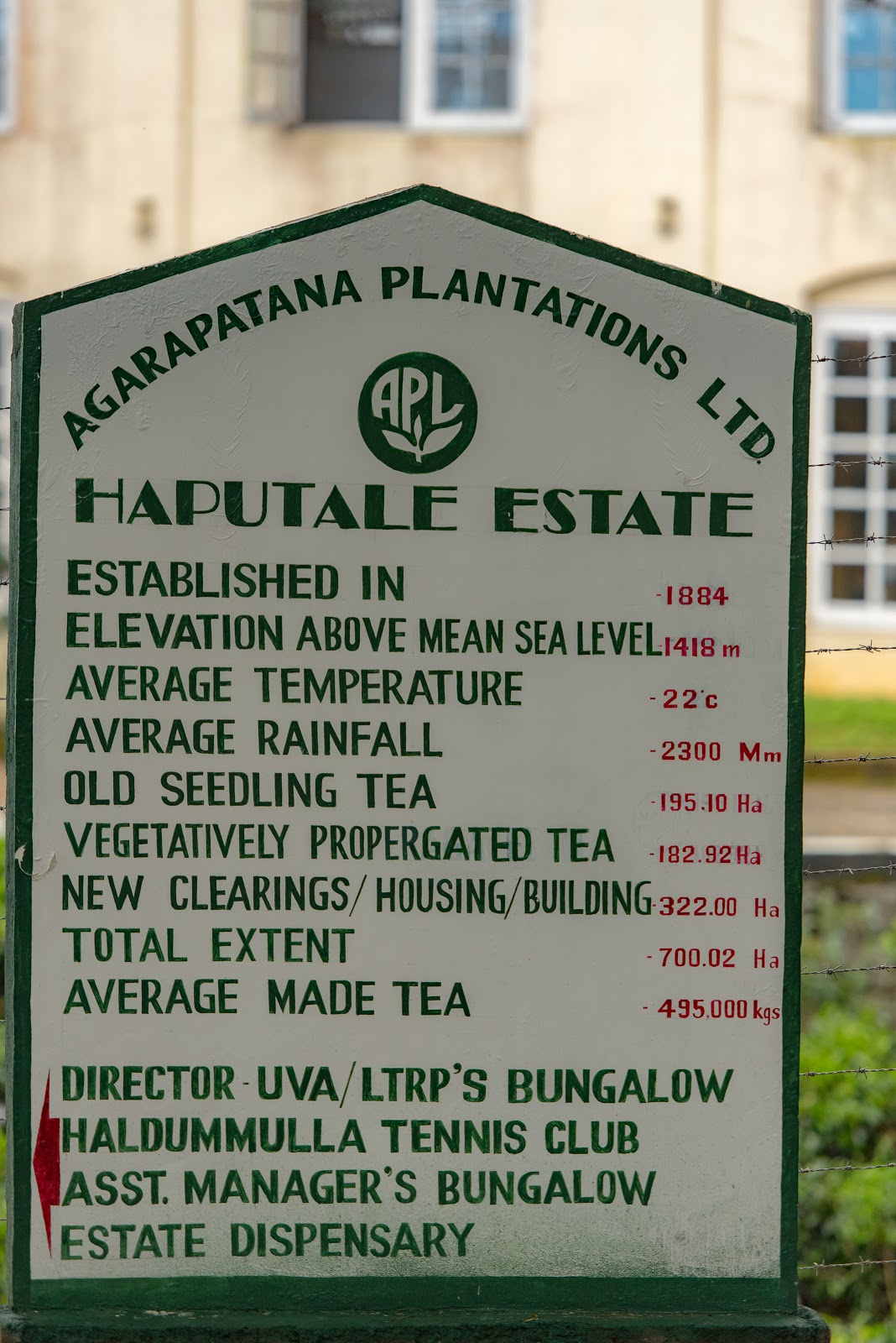
All metric tea plantation sign including hectares as Ha
© Martin Silva Cosentino | Dreamstime.com
According to materials produced during Sri Lanka's metrication, this sector was intended to be
converted properly, as can be seen by posters made about metric area measurements by the National
Metric Conversion Authority featured below. These posters are useful today in educating Sri Lankans
about metric area measurements. Though square metres still isn't frequently used, it is good to see
that this unit has been used in Sri Lanka for a long time, as in 1971 latex/oil blending for the rubber
industry estimated its cost at 50 Rupees per 100 square metres.

Sinhala Conversion Poster on Metric Area Measurements (SLNA 143/61)
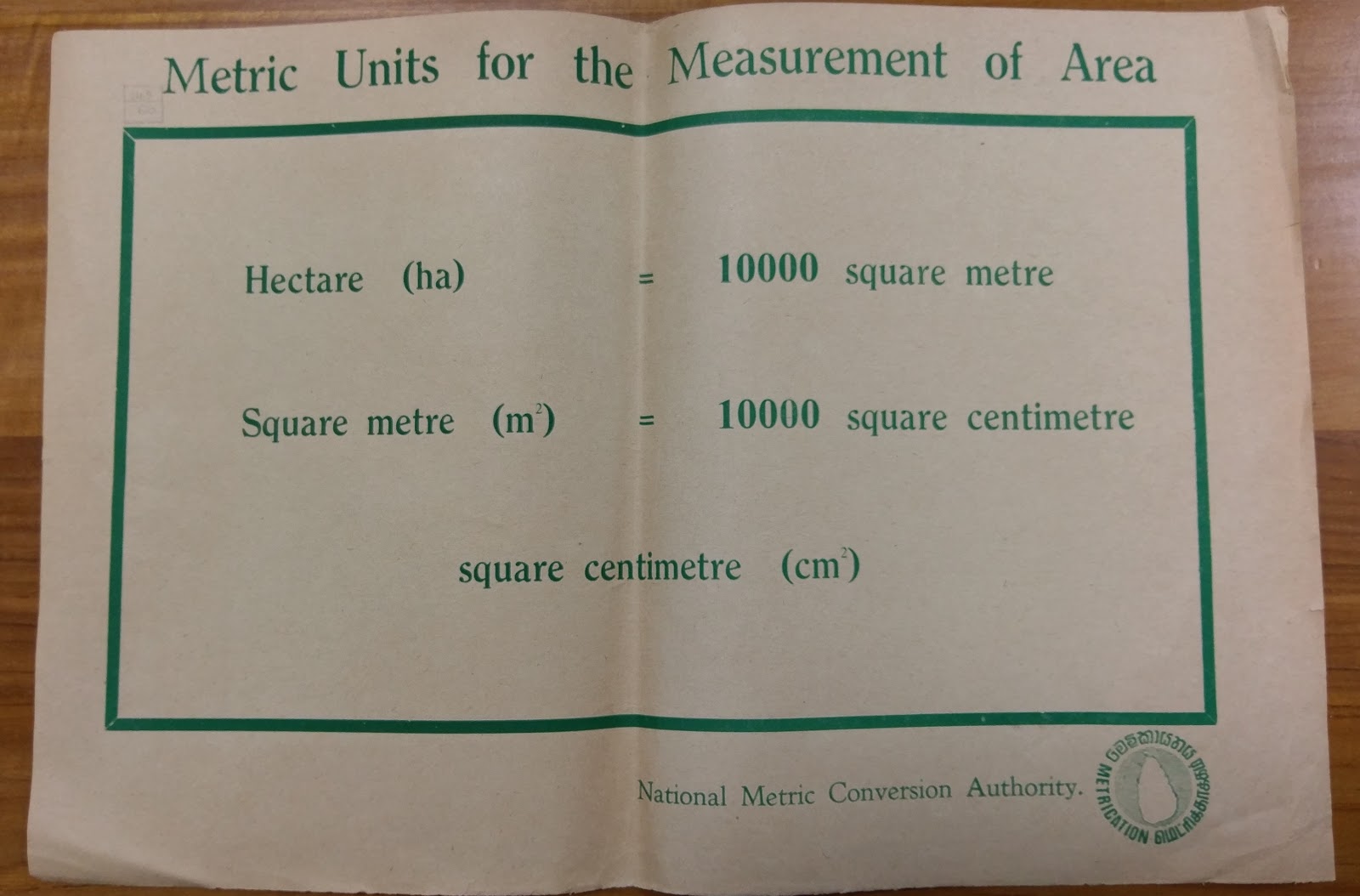
English Poster on Metric Area Measurements (SLNA 143/60)
I will mention some factors that may have contributed to the present situation. Many property
transactions are direct person to person. The Metric Units (Consequential Provisions) (Amendment) Act, No. 10 of 1983 that converted laws to metric used decimal places in its square metres conversions from square feet. There is this misconception that when listing small land in metric in Sri Lanka you would use decimal hectares instead of square metres as some government projects use this. 85 square metres sounds better than 0.0085 hectares. It is interesting to note that the 6th Departmental Survey Regulations by the Survey Department published this year, mentioned that if land surveyed has one or more decimal points in hectares, its equivalent size should be provided in square metres to assist the layman.
The government had two opportunities to educate the public and convert the area measurement sector
to metric which they unfortunately did not use. The first was during Sri Lanka's metrication, as square
metres could have easily been introduced to the general public while it was being introduced to the
construction industry. The second was with the passing of the Measurement Units, Standards and
Services Act in 1995. Those interested in this topic may wish to check out my article "The Case for
Metric Land Measurements in Sri Lanka" about this issue.
Media
The media keep using certain imperial units most notably feet, inches, imperial area units, and to a
lesser extent yards and miles. This encourages Sri Lankans to sometimes think in old units, especially
the younger generations who have been educated in metric. It is not good to see an article using feet
many times without a mention of metres after several decades of metrication.
Government
Most legislation is in metric, and there is a small amount of imperial legislation that remains either due
to those legislations having not converted or with the government's continued use of imperial in some
sectors. The government's main continuing imperial use includes feet and imperial area measurements
in legislation, regulations, projects or studies.
Confusing Mix-Ups
Having feet and inches in widespread use results in some cases of a confusing mix-up of units. I will
mention a few of these I have noticed. Doors sold with height/width dimensions in feet and thickness in
millimetres - the correct practice is millimetres for all units. Exercise books giving dimensions in inches
and paper quality in grams per square metre (gsm) - the correct practice is dimensions in millimetres
or centimetres and paper quality in gsm. It is due to an incorrect perception in Sri Lanka of the foot
being a valid alternative to the metre and the inch being a valid alternative to the centimetre that leads
to these non-legal units having official uses with laws on metric units being ignored. Going back and
forth between feet and metres which occurs in Sri Lanka can lead you to confuse one unit with the
other.
Suggestions to Complete Metrication
The main reason for some continuing imperial usage is because the National Metric Conversion Authority let the old units continue to be used alongside their metric counterparts in some sectors according to Dr. G.M.S. de Silva (Secretary of the National Metrication Board) in his article "Confusion over half-way conversions". Our continuing use of imperial in some sectors is preventing us from using the full potential of the metric system. It is unfortunate that some units that are no longer legal continue to be used. As this is the 50th anniversary of the metric system adoption in Sri Lanka, I think it is good to strive for a better usage of the metric system. This includes getting familiar with and using metric units in a sector where it is not common, e.g. road widths in metres, tailoring in millimetres, body temperature in Celsius, etc.
The following are my suggestions to complete metrication. I call on the MUSSD to carry out a study on
how well Sri Lanka is using the metric system and work to complete metrication. The MUSSD should
convert industries still using imperial including tailoring and area measurements to metric. Businesses
selling rates and/or working in old units should be required to switch. The MUSSD should come up
with requirements and give industries a timeframe to get used to it before enforcing it. They can
educate industry & the general public on body temperature in Celsius, square metres and hectares
including incorporating those units into schools' and higher education institutions' curriculums. The
media should introduce metric guidelines for their staff and metricate their newspaper property listings.
Further, future speed signs should use the correct abbreviation km/h with the existing ones gradually
replaced.
Examples of Metric Usage in Day to Day Life
The following are examples of metric usage in Sri Lanka right now.

Petrol filling station in litres
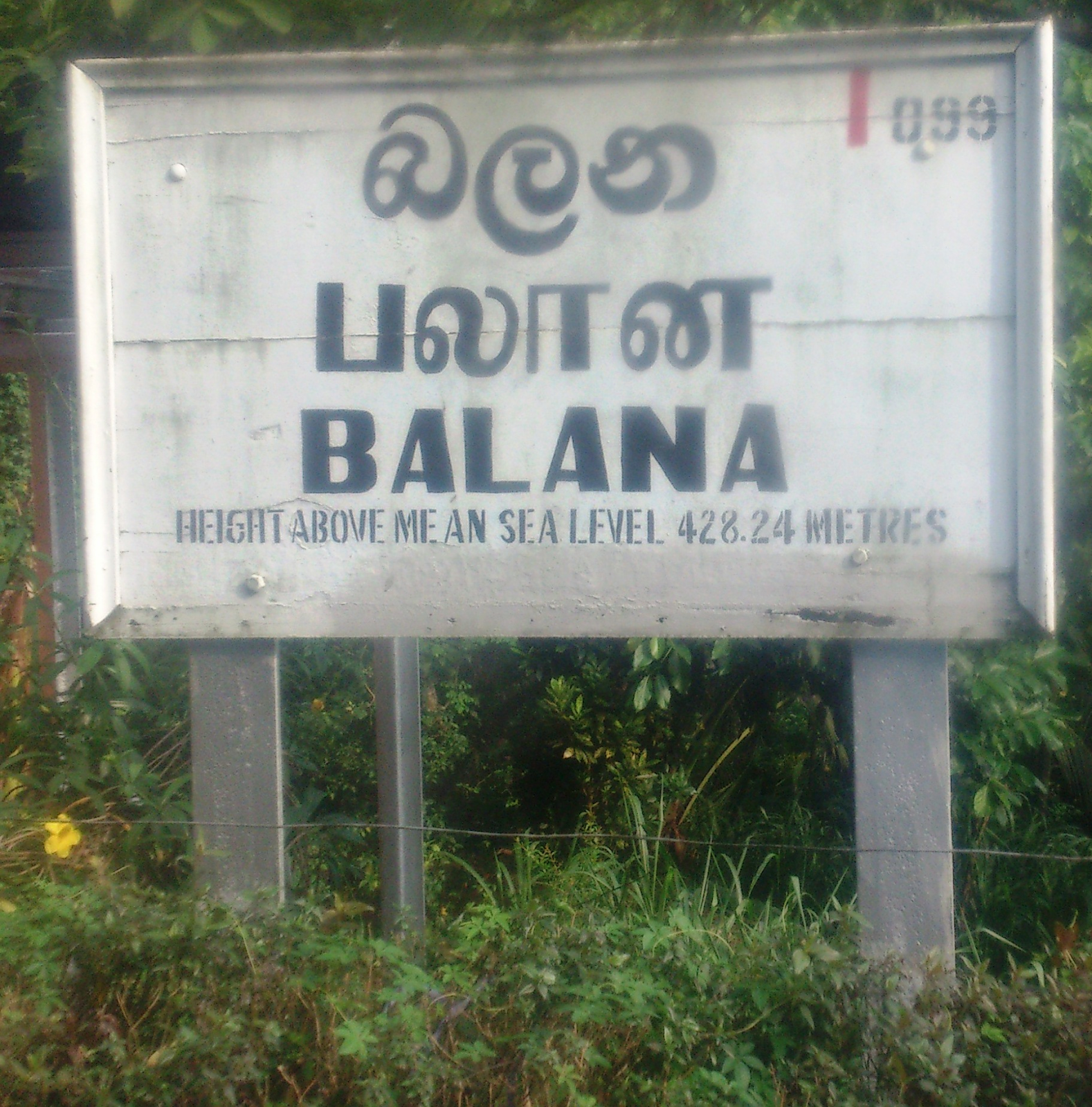
Height above sea level of town Balana at train station in metres

5 metre bridge height clearance sign

Distance sign in kilometres
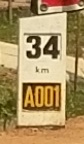

Kilometre stones


Distance signs to places in metres

Supermarket items in kilograms

5000 millilitre (5 litre) bottled water

Celsius oven

Tissue sizes in millimetres
Conclusion - Metric Sri Lanka
While it is true that some imperial usage continues, the metric system is the measurement system used by Sri Lankans. We have made significant progress from the muddled measurement of the 1980s. Metric usage has been increasing in Sri Lanka due to the younger generations being the most metricated. Even the less popular metric units square metres, hectares and body temperature in Celsius are used more. Metric units are frequently seen throughout Sri Lanka. Thank you very much to former Surveyor General of Sri Lanka Mr. Elmore Perera for taking the time to be interviewed by me to discuss metrication in the Survey Department, Director General of the National Archives of Sri Lanka Dr. Nadeera Rupesinghe for her assistance prior to visiting the National Archives and to Prof. David Robson (Architecture) & Dr. Lalith Goonatilake (Trade & Development Specialist) for responding to my queries relating to this article.
Making Sri Lanka a metric country helped the country's exports and made measurement more convenient for the country. Sri Lankans' use of the metric system in their day to day life includes purchasing food by the kilogram, filling up petrol by the litre, reading the weather in Celsius and driving distances in kilometres & speeds in kilometres per hour. Sri Lanka has used the metric system for 50 years and will continue doing so going forward.