This year marks the 50th anniversary of Sri Lanka’s decision to adopt the metric system which was a major transformation undergone in Sri Lanka. Sri Lanka had used the imperial system prior to its adoption of the metric system as the country is a former British colony. This article aims to give the story of how Sri Lanka switched to the metric system, providing the details behind the decision to adopt this system and describe what happened in the metrication process.
It’s worth noting that Sri Lanka was previously known as Ceylon, with the country’s name changing to Sri Lanka in 1972. This article will use the name Ceylon for events prior to 1972 and the name Sri Lanka for events post 1972. Similarly, the Bureau of Ceylon Standards changed their name to the Sri Lanka Standards Institute in 1974, so I refer to them in their current name post 1974. All the images featured except the one relating to the National Metrication Board were taken at the National Archives of Sri Lanka. They were taken from the Archives Holding #143 of the National Metric Conversion Authority and feature the details below each image.
Metric Usage in Pre-Metric Times
Similar to how there is currently some metric usage in the non-metric USA, there was limited usage of the metric system in Ceylon prior to its adoption. I’ll mention some of it. Ceylon’s Rupee currency had a metric related structure being in the decimal format of 100 cents to a rupee when it started in 1872. It’s unknown when it began, but cubic centimetres (cc) were used for motorcycle engine sizes in pre-metric times. Metric units had been taught for science in senior secondary schools and universities. The metric units used were older versions of the metric system, such as the centimetre-gram-second system of units (cgs).
The agricultural sector had some metric usage alongside imperial early. As far back as the 1950s, the tea industry had use of Celsius and grams for soil. That decade also had use of grams per tree tapping in the rubber industry. In the 1960s, the rubber industry had usage of litres including grams and milligrams per litre. Similarly, in the same decade this industry reported usage of Celsius, millilitres, millimetres, kilograms per square centimetre, square centimetres and centimetres. In the 1960s, grams per litre was used for blood samples in medicine.
It’s interesting to note that the Bureau of Ceylon Standards published Ceylon’s first standard in 1967 in an A5 size document. A5 (half of A4 paper) is part of the international (metric) paper sizes, which I don’t believe had been adopted by Ceylon at that time. This corresponds with the beginning of Ceylon’s metrication as covered in the next section.
Discussions to Adopt
In 1966, the organisations the Ceylon Institute for Engineering and the Ceylon Association for the Advancement of Science (now the Sri Lanka Association for the Advancement of Science) jointly urged the Government of Ceylon to consider adopting the metric system. Following that, the Bureau of Ceylon Standards formed a study group known as a Metric Divisional Committee to research the issue of Ceylon adopting the metric system. They then provided a report recommending the adoption of the metric system to the Minister of Industries and Fisheries on 24th June 1969. According to this report, among well-informed individuals there was an overwhelming desire for Sri Lanka to switch to the metric system. The Bureau of Ceylon Standards also began producing standards for the use of metric units in Ceylon. In 1969, this included standards for structural and general engineering purposes.
Adoption/Introduction of the Metric System
One year later, the Government of Ceylon decided to adopt the metric system in June 1970. The first major step they made was the setting up of the National Metrication Board. The Board’s two tasks were to prepare an implementation plan and an estimate of the expected costs of metrication. One of the Bureau of Ceylon Standards’ new metric standards in 1970 included the standard CS 99 : 1970 “Conversion Factors and Tables”. This was part of a group of standards produced at the time to facilitate international standards and practices while metricating to enable a smooth conversion.
The National Metrication Board composed of Dr. Ronald T. Wijewantha (Chairman) and Dr. G.M.S. de Silva (Secretary) with the remaining members Mr. B.J.P. Alles & Mr. E.L. Wijemanne, Mr. Eardley de Silva, Dr. M.A.V. Devanathan, Mr. Albert Edirisinghe, Mr. C.T. Elangasekera, Mr. H.L.K. Goonetilleke, Prof. S.R. Kottegoda, Prof. U.S. Kuruppu, Mr. A.M.S. Perera, Mr. D.H.N. Perera, Mr. K.D.T. Samarasinghe and Mr. N. Satyendra. There are at least two other individuals who were members of the National Metrication Board during its tenure being Mr. Baldwyn Perera and Dr. U.B.M. Ekanayake who sadly died young at the age of 32 in 1972. Both the Chairman and the Secretary of the National Metrication Board were from the Bureau of Ceylon Standards with its members comprising a variety of fields including universities, government ministries, plantations, science, opticianry and the Ceylon Chamber of Commerce.

List of the National Metrication Board members and its Panels courtesy Dr. G.M.S. de Silva
The Secretary of the National Metrication Board, Dr. G.M.S. de Silva was also incharge of the metrication division of the Bureau of Ceylon Standards. He says “This division prepared the sectoral programs of conversion as well as the new Sri Lanka standards required.” He adds “A number of sectoral committees were appointed to prepare the programs for different sectors of the economy. I acted as the secretary of these committees and guided them in the preparation of the sectoral conversion programs.” Dr. de Silva also conducted many seminars to both government and private sector organisations explaining metric units and the approaches to be taken for the conversion. He lists the end of the National Metrication Board as “when the Weights & Measures Division of the Ministry of Commerce took over the metric conversion activities they decided to disband the National Metrication Board.”
In 1971, the Bureau of Ceylon Standards’ metric standards produced included school chalk, cement and tea chests. According to a speech National Metrication Board member Mr. H.L.K. Goonetilleke gave at an October 1971 Training Workshop on Metrology in Japan, there are legal issues to consider such as the fact that the metric system was not currently legal in Ceylon. He stated that the then present imperial system would have to continue alongside the metric system during the conversion. The plan was to feature both metric and imperial units in the schedules of Ceylon’s weights and measures law amendment. Ceylon’s law allowed schedules to be amended via the Government Gazette without the need for Parliamentary approval. Once metric conversion was finished in a specific sector, the imperial units for that sector would be deleted.
In 1972, the Bureau of Ceylon Standards’ metric standards produced included wheat flour, white bread and drawing boards. The National Metrication Board presented its report to the Minister of Industries and Scientific Affairs that year. The implementation plan was the key part of the National Metrication Board's report which provided a 10 year time frame for the conversion. According to former Surveyor General of Sri Lanka T. Somasekaram in page 125 of his book “Surveying Stories” (2001), in 1972 he was part of a Survey Department Metrication Committee alongside Mr. R.A. Goonewardene and Mr. A.M. Cumaraswamy. After they produced a report, Mr. Somasekaram went to India (which had adopted the metric system in the 1950s) the following year for a Commonwealth study tour to compare the Survey Department’s conversion proposals with how India carried out its conversion in that field.
In the early 1970s, the London Tea Board (a destination for exports of Ceylon Tea) began operating solely in metric units. They wanted tea sent to them packed in metric sizes or at least having the equivalent weight in kilograms provided. They provided Sri Lanka conversion tables which on investigation revealed that each tea chest was required to be rounded down to the closest lower kilogram value. From basic calculations done on a year with low tea prices, it revealed that Sri Lanka would encounter a significant loss of revenue this way. This event probably speeded up the country’s commitment to metrication.
In 1973, metrication in the rubber industry included converting gauges, scales, charts and measuring vessels to metric. The Bureau of Ceylon Standards’ new metric standards included untrimmed paper sizes & paper board, files & folders and rulers. The Cabinet of Sri Lanka ratified key metrication recommendations from the National Metrication Board’s report. Plans for implementation were set-up via the Ministry of Internal and Foreign Trade with the National Metric Conversion Authority established.
The Ceylon Institute of Marketing (now the Sri Lanka Institute of Marketing) created ‘Your guide to Metric units’ posters presumably in consultation with the National Metric Conversion Authority educating the public about metric units. These posters were part of a campaign known as ‘Think easy think Metric’.

Your guide to Metric units poster on weight (SLNA 143/33)

Your guide to Metric units poster on length (SLNA 143/36)
Legislation
A major step of legislation was to amend the Weights and Measures Law in Sri Lanka. This law was the Weights and Measures (Amendment) Law No. 24 of 1974. It established the metric system as Sri Lanka’s base units of measurement. The version of the metric system adopted was the International System of Units (SI). SI Units is the most modern form of the metric system, which was established during the General Conference of Weights and Measures (CGM) in 1960. The Sri Lanka Standards Institute’s new metric standards in 1974 included building timber, plastic spectacle frames and ISO metric screw threads. Conversion for the rubber export industry began that year.
Sri Lanka’s customs went metric in 1975, according to Vol. 5, No. 6 (page 5) of the Canadian publication “Metric monitor” (1978). On the 2nd of April 1975, the Colombo Tea Auction went metric selling teas per kilogram. On the 24th of June 1975, the Coconut Marketing Board gave instructions to auctioneers, shippers and millers to use metric units in transactions of Coconut Oil, Copra, Desiccated Coconut and Coconut Shell Charcoal. These changes came into effect on the 1st of July 1975. Exports and imports had converted to the metric system on a voluntary basis by the end of 1975. It was voluntary as the National Metric Conversion Authority lacked the authority to enforce a conversion to the metric system. This would be rectified with legislation the following year.
The National Metric Conversion Law was passed in Parliament in 1976. It gave the National Metric Conversion Authority powers to implement the conversion to the metric system. According to the law, the Authority consisted of seven members appointed by the Minister. The members are the Chairman who belonged to the Weights and Measures Division assigned with the topic of Trade, four representatives from the Ministry assigned with the topics Industries, Planning, Finance & Local Government, a representative from the Sri Lanka Standards Institute and someone who was not a public officer who was familiar with business activities. The Minister had the power to increase the number of members of the Authority up to eight. All members of the Authority except for the Chairman were to be part of the Authority for three years unless they left office by resignation, death or removal. The Minister was to decide the length of the Chairman’s term of office.
The National Metric Conversion Authority comprised five technical and two administrative staff according to “Metric monitor” (1978) Vol. 5, No. 6 (page 5). Its members included Mr. H.L.K. Goonetilleke (Chairman), Dr. Thilaka S. Weerakoon (Director), Mr. H.L.R.W. Madanayake and Mrs. Devalakshmi Balasundaram. It’s interesting to note that Mr. Goonetilleke was part of both the National Metrication Board and the National Metric Conversion Authority.
The exact titles the last two individuals held is not known, but Mrs. Balasundaram was in charge of all the legislative changes for Sri Lanka’s metric conversion. Her colleague Mr. Madanayake paid tribute to her work on metrication in her obituary as “It was during the metric conversion of Sri Lanka, Mrs. Balasundaram joined the small group of officers who formed the core group, managing the metric conversion under the leadership of Late H.L.K. Goonetilleke, the chairman of the National Metric Conversion Authority. Her main task was the drafting of the acts. Regulation and direction under the metric conversion, proposed by the technical committee had to be implemented, legally. She had the required knowledge, skill and attitude for the task. The scientists in the technical committees knew very little law and the legal professionals knew only a little science. A bridge was required to span this gap and Devalakshmi fitted in perfectly. She could question the technocrats at length to get their ideas in an understandable way to transform them into a form more suited to the legal world”. He adds of her role in amending laws as “Even during the metrication periods, the department relied on her for advice on the legal problems arising from other acts and ordinances the department was implementing.”
Conversion Process
The National Metric Conversion Authority produced posters in English, Sinhala and Tamil. One series was about different fields of measurement e.g. Measurement of Temperature. Examples of these posters are given below.

Poster on Temperature in English (SLNA 143/57)

Poster on Temperature in Sinhala (SLNA 143/55)
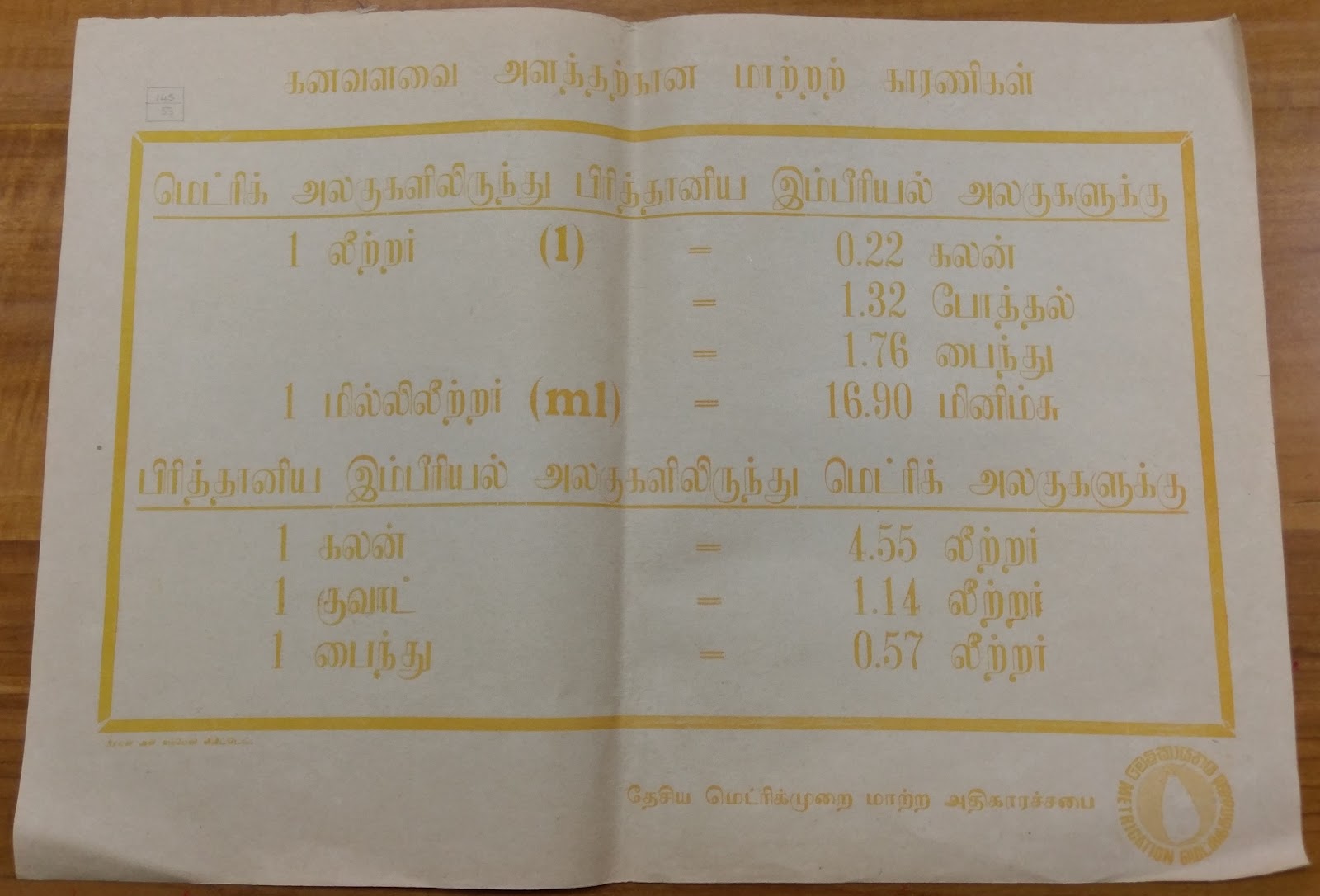
Poster on Volume in Tamil (SLNA 143/53)
One aspect of Sri Lanka’s metrication was the setting up of the Standard Weights and Measures Laboratory as reported in Vol. 7, No. 6 (page 2) of “Metric monitor” (1980). Metric measurement standards were obtained by this laboratory during Sri Lanka’s metric conversion. It’s interesting to note that there was another institute involved in metrication known as the National Metrication Institute. They had published a Tamil publication known as ‘Ilankaiyam metri alavai muroyum’. Information about who they were and their function is not available.
In 1976, the National Metric Conversion Authority’s plans for the year included work in the import trade, primary export products and initiating changes in industry. 2.89% of weights and measures tested and stamped as part of the Weights and Measures Ordinance were in metric units, indicating that conversion was just beginning in the sale of food vendors. Two factories, being the National Textile Corporation Factory and the Lanka Wall Tiles Factory were designed and built in metric units. Kilometre signs were installed by the Department of Highways on A class roads. A class roads, also known as trunk roads, connect provincial cities with major ports.
There was a press publicity campaign carried out on the metric system. The Agro-Exhibition event in Nuwara Eliya featured a metrication stall. The National Metric Conversion Authority published two agricultural publications which were “A Metric Guide for the Rubber Grower” and “A Metric Guide for the Tea Grower”. Major changes began in the industrial and plantation sectors and following that in civil engineering and education. According to Vol. 4, No, 20 (page 8) of US publication “Metric Reporter” (1976), in the last quarter of the year there was incredible success in the conversion of exports. All major exports which included tea, rubber, coconut, spices and citronella oil were all mentioned, packaged and auctioned in metric units.

“A Metric Guide for the Tea Grower” publication (SLNA 143/1 A.B.)

Page from the publication on conversion (SLNA 143/1 A.B.)
During 1977, the Sri Lanka Standards Institute’s involvement in metricating Sri Lanka Standards included volume measures, metric measuring spoons & cups, engineering, textiles, paper sizes, doors & windows and road signs & symbols. Assistant Director of Standardisation at the Sri Lanka Standards Institute Mr. Rasa Rajeswaran was actively involved in metrication. There were two notable seminars on metrication that year. Firstly, the Agrarian Research & Training Institute hosted one on metrication and measurements in industry. Secondly, the National Metric Conversion Authority in collaboration with the State Engineering Corporation and the Asian Productivity Organisation were responsible for a seminar dealing with metrication in the construction industry in November 1977. The event was called “On Rationalisation in the Building and Housing Industry with Emphasis on Metrication”. This seminar produced a paper called “Effects of Metric Conversion on Quantity Surveyors and Estimation” by Mr. H.D. Chandrasena.
In 1978, metric usage for manufacturers was in the early stages with 15% operating in metric, 60% converting and 25% planning as mentioned in Vol. 5, No. 6 (page 5) of “Metric monitor” (1978). Major progress was achieved that year. The National Metric Conversion Authority collaborated with other agencies to produce the manual “Recommended Practice for Building Drawing”. This manual related to the engineering sector, enabling building plans and building drawings to be developed in metric units. For the timber industry, tables were produced on timber production and application. Registration specifications for motor vehicle licences were prepared in the metric system. The Department of Health prepared the document “A Guide for Metric Dispensing”. The National Metric Conversion Authority provided assistance to the Department of Agriculture to function in metric units by the end of the year. On 16th August 1978, the Metric Units (Consequential Provisions) Law, No. 40 of 1978 was certified. This law amended existing laws to incorporate metric units. The newly set-up Urban Development Authority defined commercial buildings in metric terms as those having built-up areas above 10,000 square metres. According to Vol. 7, No. 6 (page 2) of “Metric monitor”, textiles began being sold per metre in October 1978. The sale of petrol in litres began in Colombo as well as in the other two key cities of Kandy and Galle. This initiative was gradually rolled out to other parts of the country.
In 1979, there was another amendment to Sri Lanka’s weights and measures law. This law was the Weights and Measures (Amendment) Act, No. 16 of 1979. Its changes dealt with the role of price control inspectors and definitions of metric units in length, area, volume & two scientific units dealing with radiation. According to Vol. 7, No. 6 (page 2) of “Metric monitor” (1980), sectors with remarkable progress of full or partial metric usage in 1980 included packaged goods, industry, education (SI was taught in high schools and partially for architectural students & technical faculties), statistics, construction & civil engineering, road & railway transportation (road signs for speed & distance in kilometres and vehicle features) and agriculture (tea, rubber and paddy).
In an April 1980 speech by Sri Lankan Assistant Superintendent of Weights and Measures Mr. A.P.H.G. De Waas Gunawardena in Washington D.C., he mentioned two interesting points about Sri Lanka’s metrication. Firstly, when it came to products sold in packages and containers, the items tea, toothpaste & paint began to be sold in fixed metric sizes under the metric conversion law. For other products, it is valid if the equivalent metric size was mentioned. Secondly, the petrol pumps originally used imperial gallons (4.55 litres) and were being converted into litres. Following the conversion, inspectors verified and stamped the petrol pumps. These petrol pumps’ numbers spin indicating the amount of fuel loaded. As litres are more than four times smaller than gallons, a frequent problem occurred of it spinning too fast resulting in the device breaking down more frequently. In addition to this, the petrol pump meter often went out of calibration and required an inspector to break the mark of authentication. Petrol station dealers would have to get their broken down pumps repaired fast to serve their customers.
During the 1980 - 1981 period, conversion was carried out in the work of the Survey Department. Work had begun on improving the readability of the 1 kilogram scale which presumably related to food vendors. The National Metric Conversion Authority collaborated with the Petroleum Corporation for a pilot project testing petrol pumps. Similarly, they also collaborated with the University of Colombo’s Department of Physics on three under-graduate projects. In 1981, the National Metric Conversion Authority tasked about 10 individuals to repair & manufacture weights & measures. During that year, the Motor Traffic Act was amended as the Motor Traffic (Amendment) Act No. 21 of 1981 changing its regulations from imperial to metric. Similarly, the Coast Conservation Act No. 57 of 1981 was enacted which incorporated new metric environmental regulations using the units hectares, cubic metres, metres and kilometres. The Sri Lanka Standards Institute made amendments to standards which included CS 5 : 1970, CS 30 : 1968 and CS 69 : 1969. These amendments were changing them from being in both imperial and metric to metric only.
As a result of the 1977 building and housing metrication seminar mentioned above, a decision was made to have a Sri Lankan Method of Measurement for construction projects. This was sponsored by the National Metric Conversion Authority with a committee appointed to develop this standard. It was published in 1982 by the Sri Lanka Standards Institute as “Standard Method of Building Works - SLS 573.1982”. On 10th February 1983, the Metric Units (Consequential Provisions) (Amendment) Act, No. 10 of 1983 was certified which amended the previous Metric Units (Consequential Provisions) Law, No. 40 of 1978. This law amended existing laws to incorporate metric units. Sectors affected by this law included electricity, bread, estates, rubber, tea, housing and customs.
Final Thoughts
Metrication was an important transformation undergone in Sri Lanka modernising its measurements making them up to date with international standards. It’s good to know that metrication was one of the few issues in Sri Lanka with a bipartisan political consensus according to page 39 of T. Somasekaram’s book “Surveying Stories” (2001).
There are some individuals who I communicated with who helped me write this article. Thank you very much to Secretary of the National Metrication Board Dr. G.M.S. de Silva, President of the US Metric Association Dr. Don Hillger, Assistant Director (Standardisation) of the Sri Lanka Standards Institute Mr. Rasa Rajeswaran, Director General of the National Archives of Sri Lanka Dr. Nadeera Rupesinghe and Emeritus Professor of Electrical Engineering at the University of Moratuwa Prof. Rohan Lucas for their help. Click here to read part two of Sri Lanka’s metrication story, dealing with the continued metrication after the National Metric Conversion Authority’s disbandment and an evaluation of Sri Lanka’s metrication based on its current metric usage. To those who lived through Sri Lanka’s metrication, feel free to share memories from it. I’d be interested to hear things I was not really able to cover such as how the food vendors and temperature converted. It would be nice to hear if anyone has any interesting stories from metrication.