Showing posts with label Buses. Show all posts

Saturday, 26 September 2026

The Need to Revive Sri Lanka’s LRT Project


In 2017, for this blog I interviewed Dr. Dimantha De Silva about the Colombo Transport Plan of the Megapolis Project. He was Consultant/Team Leader of the Colombo Transport Plan. The Megapolis and its Colombo Transport Plan was an initiative of the then Sri Lankan government. This plan included a Light Rail Transit (LRT) system which is a form of rail transit for Sri Lanka’s most populous city Colombo. In March 2019, the Daily News reported that a loan was signed between the Sri Lankan government and the Japan International Cooperation Agency (JICA) to construct an LRT Line from Malabe to Colombo Fort.


When I was interviewing Dimantha in May 2017, I was concerned that Gotabaya Rajapaksa would become Sri Lanka’s next President and cancel this project. Unfortunately, he was elected President in November 2019. Gotabaya Rajapaksa governed disastrously which culminated in Sri Lanka’s economic collapse in 2022 alongside protests which successfully resulted in his resignation. In September 2020, Gotabaya Rajapaksa terminated the LRT project. It was so tragic to see a positive transportation project get cancelled due to Sri Lanka’s broken political system. It had a very beneficial loan condition for Sri Lanka and the agreement had already been signed with JICA.


On the 23rd of July, the Daily News reported that Minister of Transport, Highways and Urban Development Bimal Rathnayake said in Parliament that a final decision has not currently been made on whether to resume the LRT project. Minister Ratnayake mentioned that compensation has been paid to two companies with one of the Japanese companies requesting additional interest payment for the delay. He also said a special committee has been formed to investigate this issue.


I am of the view that the National People’s Power (NPP) government should revive the LRT project. They are involved in positive transport projects right now. This year, the Metro Bus service was launched which continues to expand. These are modern Foton buses with the service run by the Lanka Metro Transit company. Minister Rathnayake stated in July that Sri Lanka will take steps to introduce an electric railway service in 2027. Its first phase will consist of three routes. He gave an update this month that construction is expected to begin in May or June next year.


In July, the Cabinet of Ministers approved a purchase of 600 new deluxe buses with air-conditioning. These buses are for the Sri Lanka Transport Board (SLTB). Minister Rathnayake mentioned in Parliament earlier this month that many new expressways will start construction before the end of 2026. The government just launched a national program to make dangerous and unsafe parts of roads outside of highways safe. On the 18th of this month, the government signed Memorandums of Understanding for this program with local government bodies. Prasanna Gunasena, Deputy Minister of Transport and Highways revealed on the 20th that the construction of Kandy’s Mahaiyawa’s underpass is about 80% done with it aiming to be finished by December. The purpose of the underpass is to improve commuter access to Kandy and to help reduce Kandy’s traffic congestion.


Japan is involved with the Sri Lankan government’s current transport initiatives. Around the beginning of this month, the Japanese government donated seven low-floor buses to Sri Lanka in order to enhance the Sri Lankan public transport system. These bus donations are by both the Japanese government and residents of Yokohama, Japan. This is part of the Metro Bus service as the donated buses were handed over to Lanka Metro Transit, the company responsible for the Metro Buses.


The Japanese government’s development agency JICA who were set to give the LRT loan is currently involved in Sri Lankan development projects. JICA is involved in setting up a Doppler Weather Radar Network in Puttalam. It is being constructed right now and expected to be completed next year. This is funded by Japan’s Grant Aid and will help Sri Lanka prepare for disasters. JICA provided loans for two cardiac treatment complexes in Trincomalee and Anuradhapura which just began construction. In July, Sri Lanka’s second largest water supply project was launched. JICA funded this Anuradhapura North Water Supply Project - Phase II. This month, it was reported that the Kalu Ganga Water project is about to begin. It’s a JICA loan servicing drinking water needs of families in the Colombo and Kalutara districts.


Colombo having an LRT system would greatly assist with travel as the city has too many vehicles on the roads. An LRT would enable people to travel to destinations on the list at a faster speed. It is elevated keeping it separate from regular traffic on its route enabling those vehicles to go faster due to the LRT usage. Colombo’s LRT has great potential to improve Sri Lanka’s economy. Dimantha told me how his mentors and professors in Calgary, Canada (where he lived prior to my interview and lives presently) talked about how Calgary grew and its economic levels increased when Calgary’s LRT system was introduced. He also said that it enabled investors to come in for other projects. This provides potential benefits such a system would have in Sri Lanka.


As Dimantha stated to me, Sri Lanka won’t be eligible for the LRT loan once we elevate to an upper middle income country. This loan has a 0.1% interest rate for a 40 year period and has a 10 year grace period. Sri Lanka was not an upper middle income country when the interview was conducted. We reached this classification by the World Bank in July 2019, only to lose it one year later. The World Bank improved Sri Lanka’s classification this July, returning it to an upper middle income country.


Sri Lanka’s status as an upper middle income country poses challenges to a loan for a revived LRT project as we are no longer eligible for it. If we were to negotiate with JICA on reviving the LRT, we could request it to consist of the original loan conditions when it was signed. If that is not possible, there are other options to look at which could include getting other countries or organisations also involved to ease the cost. It’s important to try to have an agreement on reviving the project including compensation payments reimbursed or at least have the interest compensation requirement cancelled.


Sri Lanka collaborating with JICA on the current development projects can help us in negotiating for a revival of Colombo’s LRT. In January 2025, Minister Rathnayake took a train ride as a regular passenger. Passengers approached him about issues the train service faces. This is a positive action by the Minister in reaching out to the people and their issues. He could use his experiences of travelling on a train and learning of the passengers’ issues as a reason to see the value of a LRT system operating in Sri Lanka, both due the common value of the train & LRT and how an improved system could address passengers’ issues. The LRT can be integrated into the government’s transport initiatives. LRT would complement the current transport projects well. Metro Buses can go to LRT locations linking the two systems to benefit each other.


In light of the government’s positive transport initiatives and work with JICA, I see the LRT as a Sri Lankan project which should be revived. The fact that Japan also donated buses to Sri Lanka this year is a case of them collaborating with the current government on transport which could help with an LRT revival. An LRT system would revolutionise Colombo’s transport sector and bring tangible benefits to Sri Lanka enabling the country to develop further.

Saturday, 11 December 2021

A Look Back at 1960s Colombo

I discovered a one minute YouTube video by the Huntley Film Archives called “Colombo, Sri Lanka, around 1960. Archive film 95260”. The quality isn’t the best with a watermark, but it is in colour and it does offer a glimpse into what Colombo, Sri Lanka was like in the 1960s. This blog post is a companion piece to my blog post “A Look Back at 1970s Colombo” from a few years ago. I’ll be embedding the video below and will be giving my thoughts on it.


We see ships at sea in Colombo Port. We are soon joined by the Colombo Port Commission building in the same area which is now the Sri Lanka Ports Authority building. We see people walk outside the building. The video then moves into the Colombo roads. I see a brief flash of a double decker bus. We see the Grand Oriental Hotel. Interestingly, I attended a wedding at the Grand Oriental Hotel two years ago in December 2019. 


The Colombo Tram is featured. The Colombo Tram is a transport system that used to exist in Colombo, but was discontinued in 1960. I notice that some cars seem to be driving too close to the tram with them crossing the lines of the tram section. It’s my observation that some of the same type of small shops seen here still exist in Colombo. There are what appears to be vegetable stalls. We see the Colombo Tram again going through a narrow road with tiled roofs. It closes with an old building. I wonder what building this is.


It was good to see a look into 1960s Colombo. I notice that Colombo seems to have a strong British influence unlike now, which is no doubt as this was not long after colonialism. Colombo in the 1960s was a very busy city like how it has always been. If you have lived in Colombo in the 1960s or been in Colombo during that time, I hope this video brought back positive memories.

Saturday, 7 September 2019

Highlights from My Sri Lankan Blog Posts


I’ve been writing blog posts about my country Sri Lanka for 3 and a ½ years now. I’m very interested
in Sri Lanka and it is the topic that I write the most about on this blog. I decided to feature a post
giving highlights from ten of my Sri Lankan blog posts. I selected ten from a diverse range of sub-
topics and ones which I thought would give a good reflection of my perspectives on Sri Lanka
featured on this blog. The headers of the post are clickable allowing you to access them if you wish.
I will give a description about each post sometimes with quotes from it.

This is a blog post featuring content from Google Street View of Sri Lanka which debuted earlier that year in 2016. This is the first post I did featuring Google Street View content. I’ve done one every year, having also done ones on Colombo and the international destinations America & Dubai. Places included are Colombo, Galle, Kandy, Point Pedro, Mullaitivu, Negombo and more. I’ll be providing two embedded locations from the blog post below. The text featured is directly quoted from it. If they do not load, you can click the “View on Google Maps” button which will open it in a larger size in a new window.

Here’s Point Pedro by the sea.

This is near Wasgamuwa National Park.

“Api Kawruda” is a popular song recorded by the band Wayo. The song was written by a songwriter
named Senaka Batagoda whose version remained unreleased until December 2015. In this blog
post, I embed Senaka Batagoda’s version from his YouTube channel and say why I find the song to
be special. It’s a great song which has a classic rock feel and I include similarities I see with my two
favourite singers Elton John and Bob Seger. I’m pleased that Senaka Batagoda’s version of “Api
Kawruda” was made available globally to purchase on iTunes this year. I pointed out that I would like
this song to be discovered by people all over the world. 

In May 2017 I interviewed Consultant/Team Leader Dr. Dimantha De Silva about the Colombo Transport Plan of the Megapolis. I said the following in the introductory paragraph “The Megapolis is a massive project that seeks to improve the quality of the Western Region of Sri Lanka which includes Colombo. The Colombo Transport Plan includes improved roads, monitoring by CCTV cameras, increasing average travel speed, an inland water transport system, a modern bus service, an electrified rail system and a Light Rail Transit (LRT) system.”

A key component of the Colombo Transport Plan is the LRT system, officially known as the Colombo Light Rail. According to Dimantha, the Colombo Light Rail is expected to be about 75 km and have 7 lines. 2 of the lines is funded via a loan from the Japan International Cooperation Agency (JICA). The Colombo Light Rail has the potential for the growth of Colombo, as Dimantha mentioned how the LRT system in Calgary, Canada (where he previously lived) made the city grow and brought in more investments including in other areas.

There has been progress in the project this year. Firstly, the Cabinet of Sri Lanka approved the proposal to sign the agreement for the first phase of the Colombo Light Rail in January. Following that, JICA signed the agreement with the Government of Sri Lanka in March for the loan. The Colombo Light Rail was launched at the beginning of July. The first phase of the Colombo Light Rail is a 16 km journey from Malabe to Colombo Fort. Most recently in mid August, the project began construction with borehole testing.

In Sri Lanka, there is more talk about the negative issues that go on in the country than the positive
ones. I think that the negative issues are a real problem, but am disappointed that the negative
issues are often overfocused with positive issues being ignored. Highlighting positive happenings in
Sri Lanka is one thing I do in my blog. In August 2017, I thought I saw more positive occurrences in
Sri Lanka so I decided to write an article highlighting them. Now, I know that time has passed with
some of them no longer relevant or not living up to what was promised, but I think it does give
information on a side of Sri Lanka that is less heard. Some of them featured in the article include the

I thought I’d add some recent Sri Lankan positive occurrences over the last three months. In June, Sri Lanka’s first satellite Raavana-1 was launched into orbit at a distance of 400 km from Earth. At the start of July, the World Bank elevated Sri Lanka from a lower-middle income country to an upper-middle income country. This is based on a new country classification by the World Bank evaluating Sri Lanka’s 2018 figures. 

This reminds me of a point Dr. Dimantha De Silva made in my interview with him. He said that we won’t be able to receive the JICA loan when graduate to upper-middle income status that he predicted would occur in 1 and a ½ years time during May 2017. Through Sri Lanka’s new classification occurred in July 2019, his prediction is close to reality as the classification comes from 2018 figures. It’s good that we were able to get this loan in time. Dimantha was part of a recent positive development. He lead a project comprising of his students which entered transit data into Google Maps. Thus the railway routes throughout Sri Lanka and most of the Western Province’s bus routes have been available in Google Maps from late July onwards. This project was carried out by the University of Moratuwa’s Civil Engineering Department in collaboration with the National Transport Commission.


Lastly, Sri Lanka had another achievement when it comes to space exploration. In late August, it
was reported that a team led by Sri Lankan scientists discovered two planets outside the solar
system known as ‘exoplanets’. These planets were discovered by going through many thousand
data files captured from the NASA Kepler/K2 Mission.


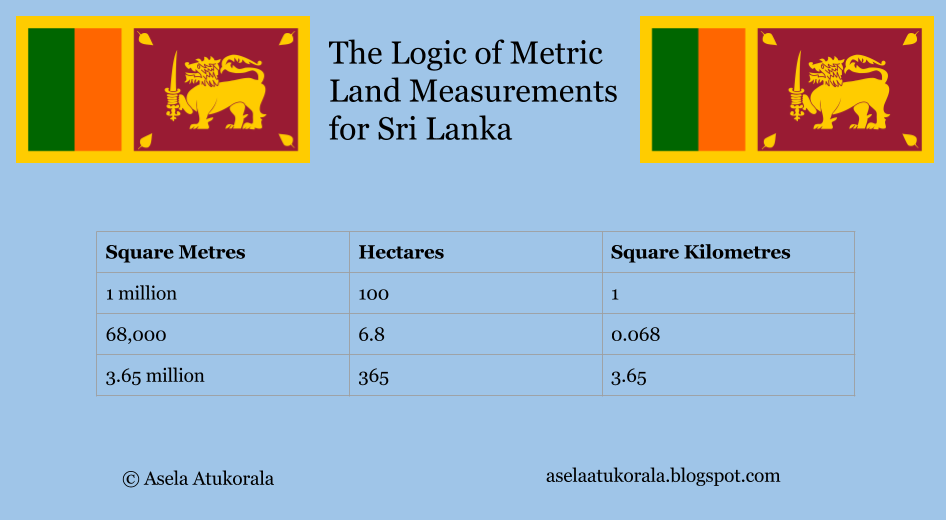
This article is written in response to the area measurement sector in Sri Lanka still being primarily
imperial, despite adopting the metric system in the 1970s. The usual practice Sri Lanka uses is
square feet for the size of built-up areas and perches, roods & acres for lands with the metric square
kilometres used for large lands. The metric units for area measurement are square metres and
hectares. I am making the case for metric area measurements to be used giving its benefits.
Benefits include the interrelatedness among different metric units as seen in the above image, the
simplicity of calculation, one unit for land and living area instead of two, fixing the area measurement
muddle, synergy with the construction industry and more. I also included metric area sizes of Sri
Lankan landmarks in it. I’m pleased that people have been finding this article on Internet searches
making it as of this writing my eighth most popular blog post. I’m also working on another article
about Sri Lanka and the metric system, that being the story of how it switched.

Metric is the preferred area units on government projects and is common on foreign funded or
assisted projects, thus one major project that is both of these is the Colombo Port City project. It is
Chinese funded, and part of the Megapolis (I interviewed Dr. Dimantha De Silva about the transport
aspect of the Megapolis) comprising 269 hectares of reclaimed land. The project also will feature
5.65 million square metres of built-up area. This includes 1.5 million square metres of office space.
According to the Sunday Times the amount of office space in Colombo (as of December 2017) in
contrast is about 300,000 square metres with 200,000 more being constructed.

I’ll now show how metric shows the difference between some of the Port City figures using my image above. The land size of the Port City is 269 hectares = 2.69 square kilometres = 2.69 million square metres. Thus, we can see that its built-up area of 5.65 million square metres is more than two times that of its land size. I’ll conclude this section with a few news stories about the Port City. It finished its land reclamation in January. In July, a Resolution was passed in Parliament that made the reclaimed land of the Port City part of the Colombo District. The total project area is 446.61 hectares, comprising the reclaimed land (269 hectares), water area (113 hectares), sea bed area (29.58 hectares), canal area (15.24 hectares) and the beach area (19.79 hectares). This development made Sri Lanka’s land size approximately 4.5 square kilometres larger.

In this article, I gave a list of good qualities I wish to see in Sri Lanka, as the country has issues
being a developing country. I’m including five of those points here.

I dream of a Sri Lanka
  • Where we have a new political culture not known for bribery, corruption, nepotism, lies, etc but to serve the nation with honesty and integrity.
  • Where we don’t have several issues of crime allowing citizens to relax for both serious and minor crimes.
  • Where the rule of law applies equally to all.
  • Where there aren’t serious issues regarding the cost of living.
  • Where all citizens are treated equally.

I’m into classic rock music, so I would love to see a Sri Lankan classic rock radio station. I think it
could work well as retro music stations are the most popular Sri Lankan radio stations right now. I
mention how I see the station functioning including songs I could see being played on it. The
paragraph below features some quotes from it put together as a paragraph.

The presenters would offer their usual commentary on topics such as Sri Lankan & world affairs and music. They would offer interviews with important Sri Lankan personalities (including musicians) as well as interviews with American and British rock musicians. As a Sri Lankan Bob Seger fan, I would love to hear Bob Seger interviewed by a Sri Lankan radio station. This station would have the American influence that I like which is common among Sri Lankan radio stations. There would be an American giving voice overs for some of the show ads and audio clips about the station that are played between shows and during ad breaks. This station would make a deal with a western company to get original recordings of songs and the licensing rights to play it. There would be competitions to win original copies of iconic rock albums.

I enjoy comic books and wrote this blog post where I gave types of Sri Lankan English comics I’d like
to see produced. Different types of stories that I discussed in the article include social commentary,
history, politics, humour, graphic novel adaptations, superheroes, sci-fi and international themes. I’m
including the sci-fi section below

Sci-Fi
Sci-Fi is the type of comic I’d most like to see. Sci-Fi is perfect for comic form as it allows the comic artists to draw creative and enjoyable imagery. Sci-Fi is at its best when it discusses the human condition. Sri Lankan sci-fi comics could discuss the human condition and of course Sri Lanka & its society.

There could be stories set in the future offering two possibilities which are:
  • A dark future showing us where we as a country do not want to go to.
  • An optimistic future showing us where we as a country wish to be. 

Another option is an alternate version of the present which could go in all sorts of different ways.
  • An alternate universe Sri Lanka which is worse than our current setup. This would show us where we as a country do not want to go to.
  • An alternate universe Sri Lanka which is better than our current setup. This would show us where we as a country wish to be. 
  • An alternate universe Sri Lanka which is neither better nor worse but simply different.

Some Sri Lankan sci-fi stories which could be featured are aliens landing in Sri Lanka (It could be in
an open way or where only a small number of people get into contact with the aliens), a Sri Lankan
inventor inventing a new piece of technology and its implications for Sri Lanka (and possibly the
world), time travel stories which go to the past and/or future, a Sri Lankan or group of Sri Lankans
travelling into space set in the present or the future.

I decided to feature a collection of Sri Lankan content from the social media site Twitter. I focused on
the month of September 2008. I subsequently wrote similar blog posts on Bob Seger and Star Trek:
The Original Series. The content I featured is tweets, which is a message of 280 characters or less.
Types of tweets I featured include economics, politics, pictures and positive occurrences. I’m
featuring two tweets from the post below including the accompanying text.


It’s good to see a story of a whale shark being rescued. It’s interesting to note that whale sharks are not harmful to humans.


This is a great photo of Nuwara Eliya taken by Rovin Shanila featured on the Sri Lankan Trends
Twitter account.

This article is advocating positivity for Sri Lanka, as negativity is very common among Sri Lankans.
In each paragraph, I give an example of a negative attitude with my thoughts on what I’d like to see
instead. I’m featuring one of the paragraphs from the article below.

People Getting Written off Too Easily
There is a trend to write off a person because of something questionable that they did, even if they
were individuals who were viewed very highly prior to that incident. I do think that some individual’s
actions can have gone too far to the point that being critical of them makes sense. However, there
are many cases where I agree with the criticism, but think it's taking it too far to write them off for it
as the individual's actions do not discredit his or her good qualities and achievements.

So that was a collection of highlights from my blog posts on Sri Lanka. I’m pleased that I was able to
reference all the key topics of this blog in this post which are Sri Lanka, Songs, Bob Seger, Sci-Fi,
and Star Trek. If you’re interested in any of my future posts, you have the option of following me via
options in the right sidebar. The sidebar also has a search function where you can search to see if
I’ve referenced or written about a topic you’re interested in. I will continue writing about Sri Lanka on
this blog and will feature many of the same issues I’ve focused on so far while also aiming to break
new ground and cover different topics.